Tuesday, March 27, 2007

IT Innovation Search AABISHKARER KHOJE

SOFTEXPO is Bangladesh's biggest showcase for software products, ICT enabled services (ITES) and ICT system solutions.

BASIS (Bangladesh Association of Software & Information Services), the largest representative trade body of Software and ITES industry in Bangladesh, is organizing this mega exposition from 28th March -1st April, 2007 at Bangladesh-China Friendship Conference Centre, Dhaka.


IT Innovation Search Program AABISHKARER KHOJE is organized by Bangladesh Association of Software & Information Services (BASIS) as a part of the BASIS SOFTEXPO 2007.

http://www.softexpo.com.bd/2007/it_inno.php

One of the Top Ten Innovative Projects of Bangladesh is selected for IT Entrepreneurship Development Program Basis SoftExpo 2004, Dhaka.

Short Listed Projects :

1.Tele-Control Over Large Geographical Area
2.Voice Activated Electronic Device
3.RUET's First Intelligent Robot
4.Voice and Visual Command Controlled Robot
5.Secured Personal Information Access System Using Telephone
6.A/V Broadcast System of Cable TV
7.TV Over LAN
8.Home Security System
9.Multi Speaker Detector/ Separator
10.Simulation of 8085 Assembly Language Programming Kit

And we are glad to announce that our project Voice Activated Electronic Device is ranked as 2nd .

Our team members are:

1. Khaled Mahmud - CSE L4/T2 - 0105025
2. Humayun Arafat Sagar – CSE – L4/T2 - 0105023
3. Naznin Fauzia Laboni – CSE – L4/T2 -0105014
4. A.F.M. Nooruzzaman – CSE – L4/T2 - 0105027
5. Inaba Bhuiyan – CSE – L4/T2 - 0105029


So, we are getting a stall in the SOFTEXPO-2007 to present our project to the entrepreneurs and interested IT personals.

The fair is open for all.

Thursday, March 01, 2007

After landing your first IT job: Job Advice Article

The following article is courtesy of Mr. Md. Hossain, a BUET alumnus. This can also be found at the csebuet.org website.

After landing your first IT job

Md. Hossain
Email: mdhossai@gmail.com

To thrive and survive in a new career, first and foremost, you need skill to get the job done, eagerness to demonstrate the ability to learn new stuff and quality to apply the learning. People and communication skills are also essential to showcase your capability. And your out-of-college skill alone may not be enough to ride in corporate-highway. Positive attitude, good communication, professionalism, sense of humor etc will play a key role in your success. There is always room to improve and a few how-to-get-it-right things are mentioned here.

General:

- After landing in a job, first couple of days, make it high priority getting settle down with cubicle, work station, network access, HR-Paper works etc.

- If company offers sessions such as new-hire-orientation, ergonomic classes, and HR-Benefits' briefings, do not miss them. Collect all brochures or notes and read them to make your decisions.

- Identify the key people or team members that you would be working with. Whoever you meet with keep a positive attitude, look in the eyes of that person, introduce yourself politely with a smile.

- After introductory Hi-Hello days are over, someone in the team, will give you an overview about the projects in hand. You might not be able to capture all the knowledge transferred to you, so get a pen and paper ready to take notes before you go for such session with a peer or manager.

- Before start writing code you might want to look into, if there is any, source code management system or version control system(such as CVS, Perforce, VSS etc) which is the repository of the source codes for the projects. This will help you to find the existing approved/project code that has been written by others. Also it might provide you some clues to solve a new problem that you've been trying for last few days since you've joined.

- It's a good idea to ask your manager or peer whether the team follows any specific coding guide lines or development practices that you're not aware of.

- In first few months (say first three) people usually won't expect you to do a critical project, all by yourself. Though it would be great if you can do it. For a good first-hand impression, you need to work hard to demonstrate the skills that you've mentioned in your resume. If you've said that you know programming C language well, people would expect you understand most aspects of C language. Remember your learning capability is the key to success in your job. What really matters to your manager/supervisor far more than anything else, is your basic technical skill and ability to understand new technology quickly. So make sure, while company's money will pay your bills / fills your wallet, you take time to learn and contribute to the company. Do not worry even if it costs few extra hours on top of regular business hours. Moving forward, this definitely will pay off.

- First few days/weeks spend as much time as possible to understand system that you'd be working with. But do not show too much seriousness to your peer. Just relax and learn the projects while making most out of it. If all the applications you're assigned to work run on unix only and you never have used UNIX, do not get nervous, take little time to learn few basic UNIX operating system command first. Then, if needed, learn advance stuff. Do not just sit down because you never used UNIXes. Go some extra mile, If you never have done linux , install linux at your home and do practice, if need to be break it and rebuild. The bottom line: try to get a handle as much as possible within short period of time. Even if you've found yourself in the middle of nowhere do not panic. Remember first few days is not getting job done, but to learn what you need to do for the job and familiar with tools and techniques that you'll be using. If every one uses VI/VIM editor and you are not familiar with any other editors in UNIX, get your feet wet with VI. Do not read manual only do it hands-on.

- Do not keep asking silly/easy questions to your peers at office. It's good to ask/clarify a question and you should not be afraid doing so. But for simple queries you can always take advantage of google/wikipedia. For instance, if you're looking for differences between xterm and vt100 terminal emulator you probably would be able to get the answer in few clicks at google searching. Asking too many silly questions will leave an impression that you're not analytical or thoughtful. Also it might well advance show that you're a very junior person before even you've a chance to show your ability. Remember in the usenet, people always want you to go through the existing archive before asking questions. Same here, do your own home work, before asking simple questions. That way even if you ask silly ones you'd be able to grasp the depth.

- If you think that it would be better to learn some stuff, ask your boss whether is it ok to buy a book or online subscription such as safaribookonline / elementk or other sources (such as short courses offered by some institution say Berkeley extension).

- If you'd like to get noticed quickly, take initiative. If there is anything that you could lend a hand, do not hesitate to bring it to the attention to your boss. Ask him what is his goal for the team for next few months and let him know your strengths in areas where you feel you could fill void on top of your day-to-day job responsibility.

- Do not allow recurring mistakes to happen repeatedly or regular basis. If lead developer ask you to indent your code properly, try to follow it. Make sure you do not get same warning from your superior for same thing again and again. It will create a very poor impression about your work-ethics. If you really think the suggestion does not make sense, try to come up with alternative ideas. But be confident enough that your ideas have solid base, and in line with industry standard or at the least follow current standards.

- If this is your first job you might not have a fat wallet. Still every now and then try to join with a peer for lunch. It does not have to be in regular basis. It will help build relationship not only as friend but also as team. Remember you do not need to pay for your colleague's lunch unless you want to. And no one expect here that you pay for his/her lunch, even it is some one of opposite sex. If the company has video game console, pool/billiard, foosball facility try to enjoy it with a peer or join with a group. That way you will not feel lonely or left alone. Always think yourself as part of the group and integrate yourself. If you're shy, it might be hard to make friends. But there are some easy techniques how to break ice. Find out some online resources for this matter.

- If you're not 100% sure about the outcome of anything, do not try to correct a senior person how to do it. Just a simple example, if a senior person is trying to see all the files in a directory of linux system, he simply typed ls, do not jump on suggesting right way that he should have typed ls -lart. There is possibility that he might have already made an alias for his command to do so.

- Do not visit porn/adult/offensive sites using your computer at office or at home using office laptop. Some companies do not mind but others are very restrictive regarding offensive material. It could even infect virus in your computer. You probably do not end up at the source of virus across the company network.

- Do not install third party tools in your office computer w/o knowing the policy for such provisions. Do not install pirated software in your office laptop or desktop.

- Keep your personal e-mails personal. Means use a third party account such as (gmail/yahoo) for your personal emails. Because most cases your company owns your email box. Though they won't intrude your mail box, but there is no guarantee.

- Do come up with new ideas in your job. Remember the idea behind companies like Google, Cisco, Yahoo, Sun Microsystem all were (the ideas behind) incubated at Stanford University by the graduate students while doing research/graduate thesis. Find out ways to do things differently and efficiently.

- If you've decided to leave the company, do not start using your sick-leaves in a hurry. Do not stock up you home desk with company's stationery. By any chance if you do not like your job, leave with dignity and in a graceful and professional manner. If possible send a nice note to everyone, that you're leaving and use an email address do they need to contact with you again. Remember you might need some of these people in future for reference purpose.

- Maintain a professional attitude but do not be too phony in a casual setting.

- Keep in touch with the latest technology in your area of interest/work. Pay attention to blogs, technical journals.

- Do not use middle finger in pointing something.

- Do not stick any political logo/political picture in your cubicle.

- Do not use a pirated/illegal/restricted copy of software at your office computer. Say your boss has bought a software with single user license. Do not use the key to activate same copy for you, even if it allows you to do so. This is a violation of software licensing.

- Try to avoid speaking your own language with a peer in front of other team mates who does not speak same.

- Limit visiting online sites frequently which are not directly related to your office purpose. Do not click on spam email links to see what's been sent. It might open up a can of porn sites, that might leave you an embarrassing situation especially when you'd be unable to close your browsers.

- If not needed, do not talk about politics and religion. Do not talk some one's sexual orientation(gay/lesbian/bi/straight etc)

- If you build up intimate relationship with someone, if it's a woman, remember ... against her will is against the law.

- Do not keep saying 'pardon me', 'excuse me' , 'I'm sorry' repeatedly and on every occasions.

- Do not nod to yes with everything from your supervisor or other team members or other departments. In one of my jobs, in a role some what close to sys-admin, I used to say yes whoever request anything. This creates a miserable situation in time management and getting core things done. Before saying yes, try to analyze the situation. Also you supposed to get to-do items mainly from your boss. So take cautions when you say yes.

- Never ask/talk about other salaries, and don't disclose yours unnecessarily.

- Always maintain a sense of good humor, but do not be funny/sarcastic all the times. Do not always take comments personally unless it was really meant to hurt you, such as 'Dude, what the f***ing code you've written, that has broken everything'. If this is not the type of code you always write, take it easy.

- During weekend/after hours do not take a outside friend to use company facilities, such as Gym, Hot tub etc, unless there is a provision to do so. Whenever in confusion check the rules with HR/Facilities for guests.

- Just before earning announcement, sometime company executives send confidential emails to employees about the summary of earnings and future forecast. Do not forward those emails to a friend asking him to buy stock as you already know the rosy details of the earnings before it disclosed to share holders.

- Do not work lot of extra hours without producing solid results. This would show that you work hard but not smart.

- Do not misuse copier-printer-phone for personal purpose. That's been said, do not waste 1 hour to go out for copying/printing. Make a balance between personal use and official use.

- Always maintain a mild tone when you're in command mode. For instance, instead of telling some one ... I've told you to do this. Have you done that? You could rephrase this as ... Do you've a chance to look into the issue? Remember being polite won't cost you anything. You still probably would receive the same answer but with win-win situation, even if the answer is negative.

- Get along with others, especially, if you're a low performer and unable to show visibility through your work. It will at least help you in the long run professionally and technically.

- keep learning new stuff, and stay on top of your academic/job related matters. If you know some areas better keep a blog or join a group where you can contribute to it through online. This will pay off in your current job as well as any future endeavors. Not to mention this will bring both money and honey in no time. People always respect someone who knows his/her areas better.

Communication:

- If this is your first job, first thing you need to put on shelf is your shyness. Being polite is good, but being shy will keep you in the bay from promotion and team work. At back-home if you're shy, people may not care about it. But here in North America, it could develop an impression that you're not able to communicate and co-operate in a team environment.

- Before communicating through e-mails or answering phone calls in office try to get familiar with online netiquette and phone etiquette. There are thousands of free online resources that could help you mastering in this arena. If you'd like to learn about online etiquette, A good place to start at RFC 1855(written in simple English, even non technical people can understand). In general, remember few rules:

- Understand different email attributes such as cc, bcc, urgent flags etc.

- Communicate with short sentences and with clarity. Always try to speak to the point before explaining it details.

- Do not send an email written in all capital letters.

- Always check spelling and grammar of your email. Now a days almost all mail clients have built-in checker.

- In a professional email do not use too many informal IM words such as great (gr8), before (b4) etc. Words like ASAP, IMHO, FAQ, BTW, EOM , ETA etc are ok. A list of such words can be found here.

- Do not send a MB attachment with an email to clog the mail traffic. If possible upload it to an internal server and send the link to your audience.

- In all cases, if possible, prefer plain-text message over html mail

- Try your best effort not to send typical formatted emails, or configuration files/source code through email. You should not assume that everybody is using same mail client as you do. The person who will execute your formatted source code might not get the same compile/run time error/success that you have had, because of the extra characters embedded in it. It may even create some non-desirable outcome.

- If you need to use email signature use it line with company's policy for official email.

- If you meet new people in meeting or in hallway try to introduce yourself in a professional manner.

- If you're in a conference call and try to make point , make sure you tell you name before dropping your thoughts. Remember everyone might not recognize you from your voice.

- When requesting meeting or scheduling it through software, make sure you mention meeting agenda. Incase if you've an office in east and another in west coast in North America, try to mention the meeting time clearly such as PST, EST, PDT etc. Do not simply rely on outlook or other scheduler to tell your participants about the timing of the meeting, even though it will automatically do so.

- Activate your voice mail in your phone with a professional greeting.

- Do not solely depend on email, on time sensitive issues, say we are releasing this product at 5 PM. Your audience might not be checking emails to get this important message.

- Do not solely trust emails. People has personal setting for spam/virus filter. Your message might end up at junk email, depending on the setting of the user. For instance if a mail sent to All caps with subject such as. PROJECT LAUNCH AT 3PM, might go to junk. If the user set all caps subject to be considered as junk/spam mail.

- Do not forward sensitive confidential emails by electronic communication to people outside your office. Your electronic communication will speak against you if further problem arises down the road.

- If you're asking someone a question, and the person is not able to understand , try to rephrase it with different words keeping the main theme in it.

- Distribute meeting notes, know how to use conference calls, send meeting minutes right after the meeting.

Relationship with boss/manager/supervisor

- Try to keep an open and honest relationship with your boss.

- Do anything that could boost the image of your boss. For instance pick up an open source code, blend it with something so that it could be a good use for something. Even a process improvement work, or a new tool that your boss find helpful for the entire team. Just show your presence in a way that resemble 'I can do' attitude.

- Be proactive ..., do not always wait for someone to tell you to do something. But make sure you talk with superiors prior to implement some important changes, such as re factoring entire procedural code base with object oriented methodology.

- Remember to look at eyes of your boss while talking whether it's a man or woman. Looking eyes gives an impression that you're not nervous and are not hiding anything.

- If your peers or a members of another team ask you to do some stuff, do not allocate time or accept it w/o consulting your boss first. Remember you're working for your boss, not for others.

Explore company's benefit package:

- Explore all the benefits that your company offers. For instance Adobe Systems offers employees up to ten thousand US dollar per year for courses taken related to their positions in the company. You can even enroll in MBA course, provided your manager approves it. Not to mention that this is extra money on top of your salary.

- Take advantage of company software, laptops, communication/electronic devices, company sponsored (subsidized) product such as gymnasium membership, books, online membership etc.

- Do not go office, when you've severe flu, cold or other sick symptoms which is very noticeable as well as painful to you. Your benefits include some sick leave. Use it as appropriate, but do not misuse it especially Fridays in Summer.

- If possible always participate 401K or other ways (flexible saving accounts) to get some free money that company matches up to certain percentage based on your contribution. If you don't participate, you're simply losing this free money.

- Participate in Stock purchase plan. Usually you'd be able to sell them 15% higher on the day it's been transferred to you. Follow the guidelines and move on your discretion.

- Some companies allow employees to buy software with nominal fees. If you need to buy useful software, do so under this category.

- If the company offers subsidized Gym for your physical exercise, if possible take advantage of it to keep your health in shape.

Others:

- Always flush the toilet after using it. Think about a situation you're coming out of the toilet w/o flushing it and your boss is getting in there.

- If there is a bathroom, for people with disability, try not to use it if you've other options open.

- Plan ahead. Do not surprise people with anything other than good professional charisma. Do not just tell your boss that your mother has found a lovely sweet heart for you to marry in back-home and you want to leave next week. Be diplomatic for that unexpected situations.

- If you've a job that requires lot of travels, feel free to use a credit card that has cash-back bonus. This will add some extra savings in your pocket with no/little cost to you.

- If you donate money to any charity, explore the company's donation matching rules. It might add extra money to your donation from company's pocket up to certain limit without costing you anything.


Monday, February 19, 2007

CSE Day Registration Info

Dear Alumni,

Department of CSE, BUET is going to arrange CSE DAY 2007 on 20th February, 2007 (Tuesday). There will be a panel discussion, prize giving ceremony and cultural evening in CSE DAY 2007. Registration information and complete schedule for CSE DAY 2007 are given below.

Program Schedule:

Panel Discussion
Topic: Computer Science and Engineering in Global Context
Venue: BUET Auditorium Seminar Room
Time: 3:30 PM - 5:00 PM

Asar Prayer and Refreshments
Time: 5:00 PM - 5:30 PM

Prize Distribution and Cultural Program
Venue: BUET Central Auditorium
Time: 6:30 PM - 8:30 PM

Dinner will be provided at the end of the cultural program.

Registration:

Alumni: Tk. 500 per person
Guest: Tk. 200 per person

Registration Deadline: 11:00 AM, 20th February 2007 (Tuesday)

Please contact the following persons for registration.

Batch 2000:
S.M. Shahriar Nirjon (nirjon_buet@yahoo.com, 0152329623)
Lecturer, CSE, BUET
Md. Ehtesamul Haque (ehtesam17@yahoo.com, 01199032314)
Lecturer, CSE, BUET

Batch 1999:
Ahmed Khurshid (ahmedkhurshid80@yahoo.com, 01711355260)
Lecturer, CSE, BUET
Md. Abedul Haque (bsc99009@yahoo.com, 01817602397)
Lecturer, CSE, BUET

Batch 1998:
Mohammad Moazzem Hossain (moazzem_hossain2004@yahoo.com, 01720179969)
Lecturer, CSE, BUET

Batch 1997:
Md. Yusuf Sarwar Uddin (yusufsarwar@cse.buet.ac.bd, 0152358680)
Assistant Professor, CSE, BUET

Other Batches:
Dr. Md. Humayun Kabir (mhkabir@cse.buet.ac.bd)
Assistant Professor, CSE, BUET

Dr. Md. Mostofa Akbar (mostofa@cse.buet.ac.bd)
Associate Professor, CSE, BUET

Hope to see you all in CSE DAY 2007.

Regards.

Ahmed Khurshid
Lecturer
Dept. of CSE
BUET

Monday, January 29, 2007

Request for Pariticipation in Bangla wikipedia

As you may have noticed, Bangla Wikipedia (http://bn.wikipedia.org ), the Open source volunteer-crafted encyclopedia, has grown a lot over the last year. In March 2006, it had only 500 articles, but now, the total entries have grown over 14,000 (including stub and drafts), with about 5000-7000 small-mid-sized articles.

Right now, Bangla wikipedia is the largest Bangla language Website in the whole world. Among 250 languages of Wikipedia, it ranks 43rd in terms of total article count.

Over the last year, we have taken initiatives to draw more contributors to Bangla wikipedia. In December, volunteers of Bangla Wikipedia visited various Mughal-era monuments of Old Dhaka and took more than 300 pictures, all of which were released under a free license ... these photos are completely free and open for all to use, without any restrictions of copyrights. (Some of the photos can be seen at: http://commons.wikimedia.org/wiki/Category:Dhaka )


But we need more people, and this is where YOU can help.

*Check out a brief intro to Wikipedia at http://www.ragibhasan.com/wikipedia

*Please visit http://bn.wikipedia.org to check out the Wikipedia,

*Sign up for it at http://bn.wikipedia.org/wiki/Special:Userlogin and contribute wherever you see useful.

*We also need a lot of photos of monuments and artifacts of the
country. You can upload any such photos (under a free license) at
http://commons.wikimedia.org/wiki/Special:Upload (with
[[Category:Bangladesh]] in the description form).

*And join our organization Bangla_Wiki\'s mailing list at
http://groups.yahoo.com/group/bangla_wiki


Why contribute? The world we live in is becoming digital, and in 50
years, anything not represented digitally will simply be forgotten or
sidelined.

Bangla is our own language, and we need to bring the knowledge of the
whole world to it, so that the children of tomorrow will have a source
to look into. Even more, we need to represent the culture and heritage
of Bangladesh and West Bengal ....

No one from other countries and cultures will come and save our own
history. No foreigner will write in Bangla about the glory of the
Lalbagh fort, or the game "Dariabandha". We need to do this ourselves.

So, this is a call to all Bangla speakers, please join the collective
effort to preserve Bangla language, culture, and heritage at the
Bangla Wikipedia.


Feel free to contact me about any question. Also, you can email the
mailing list at http://groups.yahoo.com/group/bangla_wiki


Thanks


Ragib
--
Ragib Hasan
PhD Student
Dept of Computer Science
University of Illinois at Urbana-Champaign
201 N Goodwin Avenue
Urbana IL 61801

Website:
http://www.ragibhasan.com
http://netfiles.uiuc.edu/rhasan/www

Wednesday, December 13, 2006

First OPEN Source Workshop in BUET

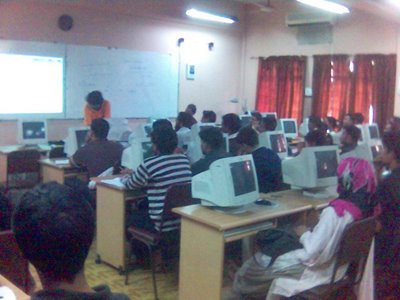
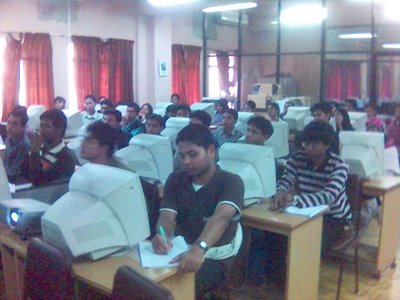
Yesterday, 12th December, we had first ever Open Source Workshop in BUET. It was held on Microcomputer Lab, 3rd floor, EME Building, from 2:30 pm to 5:00 pm long.

BUET CSE Department of Head Dr. Muhammad Masroor Ali gave us the permission to use the Microcomputer lab and allocated a Lab assistant to help us with the arrangement. Without his technical and moral support it was simply impossible to arrange and finish such an effective workshop in BUET. A special thank goes to our sir from all of us.

We also have 4 lecturers from CSE departments in the workshop. Md. Mostofa Ali Patwary, Chowdhury Sayeed Hyder, S.M. Shahriar Nirjon, Md. Abul Hassan Samee. Thanks to them also to inspire us.

In total we have 66 participants. Our Lab was fully occupied and few were standing and sharing chairs.


In the workshop we worked on the view of Open source and basic Linux installing, partitioning the hard disk and few frequent Linux commands. The program started at 2:30 pm sharp.

First, Mustafa Sarwar Nasif started with the basic question what the Open Source is. Then Khaled Mahmud continued the discussion interactively. Few questions came from the audience. And the discussion was up to 3:15 pm. Then Md. Ayub Ali and Sajid started with hard disk partitioning and basic Linux installation problems. After that, few Linux commands were introduced so that new users can easily start with the Linux. And we finished with the C/ C++ compiling and debugging examples for the junior batch of CSE, BUET.


In the last we have announced of an upcoming boot camp after the eid vacation. The date is not fixed yet. The date will be announced soon.

Our BUET OSN yahoo group link:
http://tech.groups.yahoo.com/group/buet_osn/

Thank u everybody in the workshop to make it a successful one. And the enthusiasm showed by all is praise worthy.

Tuesday, November 14, 2006

WALCOM 2007 Call for papers

Call for Papers

Workshop on Algorithms and Computation-2007

Bangladesh Academy of Sciences (BAS) is organizing a workshop on algorithms and computation on 12th February, 2007. Professor Takao Nishizeki of Tohoku University, Japan, one of the renowned scientists in the field of Theoretical Computer Science, has kindly consented to present an invited talk at the workshop. Some other renowned researchers are also expected to present their invited talks. There are eight to ten slots for contributed talks in this workshop for which papers describing original and outstanding research results are sought.

SCOPE

The range of topics within the scope of the workshop of algorithms and computation includes (but is not limited to):

· Algorithm and data structures

· Graph algorithms

· Graph drawing

· Combinatorial algorithms

· Computational geometry

· Graphs in bioinformatics

· String Algorithms

· Computational biology

· Parallel and distributed algorithms

PLENARY SPEAKER

Takao Nishizeki (Tohoku University, Japan)

INVITED SPEAKERS

Shin-ichi Nakano (Gunma University, Japan)
Subhas Chandra Nandi (Indian Statistical Institute, Kolkata, India)
Xiao Zhou (Tohoku University, Japan)
Y. Kusakari (Akita Prefectural University, Japan)

Takehiro Ito (Tohoku University, Japan)

SUBMISSION

Authors are invited to submit papers describing original research of theoretical or practical significance to algorithms and computation. Authors should submit an extended abstract not exceeding 12 single-spaced pages on A4 paper, including references, figures, title, authors name and affiliation, e-mail address, and a short abstract. Use reasonable margins and at least 11-point font. Please use LATEX for preparing manuscript. We will have eight to ten slots for contributed talks in this workshop. Please submit PS or PDF files of the manuscript to walcom2007@gmail.com. LATEX source files will be required for preparing proceedings after acceptance of the paper. See http://teacher.buet.ac.bd/saidurrahman/walcom2007/ for details.

IMPORTANT DATES

· Submissions of contributed papers: December 15, 2006

· Notification of acceptance: January 12, 2006

· Workshop: February 12, 2007

VENUE

The workshop will be held in Bangladesh Computer Council Bhaban, Agargaon, Dhaka, Bangladesh.

COMMITTEE

M. Shamsher Ali, President of BAS (Workshop Chair)

Naiyyum Choudhury, Secretary of BAS (Organizing Co-Chair)

A. M. Choudhury, Executive Director of BCC (Organizing Co-Chair)

M. Kaykobad, BUET (Program Co-Chair)

Md. Saidur Rahman, BUET (Program Co-Chair)

PROGRAM COMMITTEE

Costas S. Iliopoulos (KCL, UK)

Md. Abul Kashem (BUET, Bangladesh)

M. Kaykobad (BUET, Bangladesh) Co-chair

Manzur M. Murshed (Monash University, Australia)

Petra Mutzel (University of Dortmund, Germany)

Shin-ichi Nakano (Gunma University, Japan)

Subhas Chandra Nandi (Indian Statistical Institute, Kolkata, India)

Md. Saidur Rahman (BUET, Bangladesh) Co-chair

William F. Smyth (McMaster University, Canada)

Hsu-Chun Yen (National Taiwan University, Taiwan)

CONTACT ADDRESS

Dr. Naiyyum Choudhury

Secretary

Bangladesh Academy of Sciences

Email:naiyyum@gmail.com


Dr. M. Kaykobad

Department of Computer Science and Engineering

Bangladesh University of Engineering and Technology (BUET)

Dhaka-1000, Bangladesh,

E-mail: kaykobad@cse.buet.ac.bd

Dr. Md. Saidur Rahman

Dept. of Computer Science and Engineering

Bangladesh University of Engineering and Technology (BUET)

Dhaka-1000, Bangladesh,

E-mail: saidurrahman@cse.buet.ac.bd

Thursday, November 09, 2006

Steve jobs commencement speech at Stanford

Steve Jobs is the CEO of Apple, which he co-founded in 1976. Apple leads the industry in innovation with its award-winning desktop and notebook Mac computers, OS X operating system, and iLife and professional applications. Apple is also leading the digital music revolution with over 50 million of its iPod portable music players sold and over 1 billion songs legally downloaded from its iTunes online music store.

Steve also co-founded Pixar Animation Studios in 1986. Pixar has created six of the most successful and beloved animated films of all time: Toy Story, A Bug's Life, Toy Story 2, Monsters, Inc., Finding Nemo, and The Incredibles. Pixar has won 20 Academy Awards and its films have grossed more than $3.2 billion at the worldwide box office to date. Pixar merged with The Walt Disney Company in 2006 and Steve now serves on their board of directors.

Steve grew up in the apricot orchards which later became known as Silicon Valley, and still lives there with his wife and three children.

This post is not to introduce steve jobs... this is for one of his excellent speech at Stanford...

Here goes Steve jobs commencement speech at Stanford....


Here is the download link..: Steve jobs speech

Computer science still a good career

Moshe Vardi, professor of Computer Science at Rice University, visited UIUC last year, and gave a very captivating talk on the history of logic. Face to face, he is a pretty amazing speaker ... I am not "into" Theory, but I enjoyed his whole talk very much.

On Nov 6, Stanford University Forums discussed the job prospects in Computer Science. Prof. Vardi commented that

"There is a huge mismatch between perception and reality. There are more IT jobs now than there were six years ago at the height of the IT boom."

From the report,

Vardi presented results from a study on the global migration of software jobs commissioned by the Association for Computing Machinery, the world's oldest and largest educational and scientific computing society.

He co-chaired a task force of economists, social scientists and computer scientists who spent a year reviewing all the available data on the global impact of offshoring for the information technology industry to reveal computing is still a viable field of study and work.

"IT is still a good career," Vardi said. "We have nothing to fear but the fear of competition itself.""

So, in a way, this report affirms what I've been saying all along, the Computer Science industry is still strong, and will likely to remain so for many more years. I hope this will at least allay the fears many prospective BUET students have about the CSE department, and that it will dispell some of the rumors many parents have been hearing all the time.


The complete report from Stanford Univ Forums can be found here.

Saturday, September 16, 2006

BUET Graduates in Google: Success stories

Today's guest blogger: Manzurur Rahman Khan (Sidky)
(All opinions/information belong to the Manzurur Rahman Khan)


[Note: In this article, Sidky describes his experience in the Google Code Jam 2006, and his subsequent Internship offer from Google]

From the very beginning, Google Inc. has been the place for the most talented students everywhere. With its expansion, it is looking for more innovative and great minds from different universities all around the world. With its search for inventive people, BUET students have proved that they have what is required to be a Googler.

It all started in August 2006. Just after the ACM ICPC World Finals 2005 in Shanghai, the team members from the world finalist team were invited to visit their Mountain View campus (also known as Googleplex). The team consisted of Mushfiqur Rouf, Abdullah al Mahmud and me, and their coach Mehedy Masud. We participated in open talks about different Google products like Google Sets, Google Map, Google Scholar, GMail, Google Earth, Google File System, Page Indexing and about working environment and ideology in Google. After the 4 day visit, they asked the participants to drop their resume. Later two of us (Abdullah al Mahmud and Mushfiqur Rouf) were offered job as a software engineer. Abdullah al Mahmud was posted in Bangalore. But he had some problems regarding work permit in India and had to cancel the offer. Later he was offered job in Microsoft. He is expected to join there next year.

Again, in this year, in April, Google India arranged a programming contest Google India Code Jam. There, three students from BUET (Ishtiaque Ahmed, Sabbir Yousuf and Me) participated. There we were ranked 20 th, 22 nd and 9 th, respectively. Later after the contest, I applied for internship and had an interview. I was offered internship from May 2006 to July 2006. But, due to academic reasons, I was unable to take that offer.

Again, after the World Finals 2006, in San Antonio, Google’s quest for talent continued with the talk with all the World Finalist teams in their different Offices. This time, Istiaque Ahmed, Omar Haider Chowdhury and I, visited their Bangalore office. A team from Dhaka University has participated the talk as well. They gave lectures on Google Finance, Working environment and their methodology. Later on, 2 members from BUET team and 3 members from Dhaka University team applied for full time employment. In their interviews, they asked different analytical questions, and questions about web caching, operating systems, and different other aspects of computer science, and engineering. 2 members from DU team has been offered job, others are yet to get reply. Besides the BUET world finalist team, a graduate from BUET, Md. Sajjad Hossain, who participated in 2006 World Finals from Stony Brook University of New York, is completing in internship in Google, in USA.

Nowadays, performance in programming contests and ICPC’s are becoming more and more important to the IT giants. They are even arranging the contests to find talented programmers. I think it’s time for everyone to think of the contests seriously. It will definitely increase their opportunity, enrich their CV’s and flourish their brilliance.

Friday, August 04, 2006

Bangla Wikipedia

We are delighted to announce that, we at the Bangla Wikipedia project have declared August 2006 to be the Bangla Wikipedia month. Throughout the whole month, we would undertake various activities and campaigns to enhance, expand Bangla wikipedia, and also generate more awareness about it.


A few details are provided below:


1. What is Wikipedia? What is Bangla wikipedia?

Wikipedia is world's largest encyclopedia, open source and free for all, created by thousands of people world wide. It has versions in more than 200 languages. The largest version, the English wikipedia (http://en.wikipedia.org ) has more than 1.3 million articles, making it the largest encyclopedia in the world (larger than Britannica, Encarta combined). 10 other languages, including French, German, Spanish etc. have more than
100,000 articles. Many languages, even small ones like Macedonian (with only 2 million speakers) have 8,000 articles.

Anyone can add content or edit wikipedia, all you need is an Internet connection.

Bangla wikipedia is the Bangla version of wikipedia (http://bn.wikipedia.org ). The project is to create a general encyclopedia in Bangla, constantly updated, expanded, and enhanced. Anyone with an Internet connection, and ability to view Bangla Unicode
text, can visit the page and read/edit content.

Anyone can read it, print it, and use it for whatever purpose they want. It is given away under GNU Free Documentation License, for Free! You don't have to pay hundreds of takas to access it ... anyone with an Internet connection can access it. Even now, it is the largest Bangla language website in the whole world, with more than 3675 content pages full of images, and knowledge.


2. Bangla Wikipedia project (bangla_wiki)

Since late March 2006 (March 25), Bangla_wiki, a project coordinated via the mailing list http://groups.yahoo.com/group/bangla_wiki , is working on building the encyclopedia. This is done with help from Bangladesh Open Source Network (BDOsn). The objective is to organize the people who are active in editing/contributing to Bangla wikipedia, and to solve various issues, organize public-awareness campaigns, and so on.


3. Our achievements since April 2006

Bangla wikipedia was started in 2004, but it lacked contributors and content. Since starting the campaign in late March 2006, the Bangla_wiki project has been able to add 3200 new articles , that is, 800 new articles per month. The total article count in Bangla wikipedia is now at 3675. Through campaign, we have been able to organize a diverse
group of contributors, spread all across the globe, and from both Bangladesh and West Bengal.

When we started, the position of the Bangla wikipedia among all languages was 95. However, we have been able to raise our rank up to 69 as of last month (67 on August 3) and gradually rising.


4. Our immediate target: (10 - 1)

BBC Bengali covered our project in May 2, 2006, and we expressed our immediate goal, of generating 10,000 articles by May 2007, and at least 1000 full length articles. Since wikipedia is a collaborative process, articles are constantly edited, expanded, and enhanced. Each article is begun as a few lines, but gradually grow up to full length.

We plan to achieve our target : 10-1, i.e. 10,000 articles, and 1000 high quality articles in 12 months. With the rate of 800 or more articles per month, we are right on course.


5. What you can do?

Participate!! We need more people to edit, spellcheck, enhance, translate, and so on. Wikipedia is built by volunteers, and is provided to the whole world as a free source of content. Bangla is our mother tongue, and it is our duty to preserve the knowledge of the
world in Bangla language, so that the children of tomorrow will be enlightened.

Knowledge, unlike money, grows when it is given away, so each sentence, each bit of information you add to wikipedia will grow many times.

  • To participate, you can visit http://bn.wikipedia.org and start editing. You can and should sign up, that gives some additional benefits, and takes at most 15 seconds.
  • To view Bangla unicode, and type in Bangla easily, you can get Bangla typing systems like Avro , or Avro (mirror), or Shabdik, Ekushey.
  • Do you have to be a scholar or specialist?? NO!! Your enthusiasm and love for Bangla are all you need. Just add information you know, with a link to the source ... but in any case, don't worry, we can guide you into adding information there. Once you join the Bangla wikipedia, an administrator will provide you with the guidelines on how to edit, what the policies are, etc.
  • You can also sign up in the group Bangla_wiki. If you have any problems, you can post there.
  • For a quick tutorial in Bangla, about how to edit in Bangla wikipedia, you can view http://www.ragibhasan.com/wikipedia . This has some info on basic syntax, which you can learn in about 5 minutes. Note that even if you haven't set up Bangla unicode yet, you can check this tutorial.
So, please, come join us, in this project to make a strong presence of Bangla language in the Internet.


6. Month long Programme for Bangla Wiki

As mentioned earlier, we have declared August 2006 as the Bangla wikipedia month. Under this programme, we, the Bangla_wiki project will do the following:


Proposed Programme

A. We will observe declare the last Saturday of the month as the "Bangla Wikipedia Day" , and have day long activities to promote Bangla wikipedia.

B. Campaign: Generate public awareness about the free open source Bangla encyclopedia, collecting open content such as images / photos of the sights and sounds of Bangladesh.

C. Camp/Workshop: Organize camps and workshops about how to edit/contribute to the Bangla wikipedia. This will be done in various universities

D. Publication of booklet/leaflet: Free Booklets will be published and distributed, detailing how to edit and contribute to Bangla wikipedia.

E. Publishing articles in electronic and print media

F. Opening a wiki hub to support the wikipedian: Many people in Bangladesh do not have regular Internet access. To allow them to contribute, their content can be emailed to us, or sent by post to the Bangladesh Open Source Network office (address to be provided soon). This way, we can allow everyone to participate.


G. The existing bangla wikipedians will edit/write at least 2 edits/day or 50/edits per month.


Let's show our love for Bangla, and make Bangla wikipedia the largest repository of knowledge in Bangla language.

Monday, July 31, 2006

6 crore Taka versus the power of open source

I was reading Daily Bhorer Kagoj today, where I read some news about Banglapedia (how it is being pirated). Anyway, a portion of the news was the announcement about the 2nd version of Banglapedia, to be published by 2008. The Asiatic Society gave an estimate of 6 crore taka.

Link to the news item (Requires IE and some non-unicode fonts to view :( )

I'm quite astonished at the huge amount of money being spent in that way. True, a paper encyclopedia needs a lot of expenses. The writers are paid ... the office staff need to be paid and so on.

That's why the power of open source is so great ... in only 3 months, we were able to create 3000 entries in the Bangla Wikipedia, with only 10 people working in our spare time. True, many of these entries aren't complete yet, but I just gave the example to show how the open source collaborative effort can achieve better results than committees and paid writers.

So, in Bangla wikipedia, we can have a target now ... to build a great Bangla encyclopedia, which can definitely rival Banglapedia. Of course, Banglapedia only covers topics related to BD, whereas Bangla wikipedia is going to be a complete encyclopedia, covering all areas of knowledge.

Let's get up to 10,000 articles by next year, as I predicted last may in the BBC interview. And best of all, our knowledge in Bangla wiki is going to be given away free for all the Bengali speaking people of the world!

Banglapedia publishers -- our great intellectuals of the Asiatic Society of BD -- lamented that Banglapedia is being pirated in West Bengal. Well, we don't mind at all if anyone gives away Bangla wikipedia ... after all, "if you give away knowledge, it grows, unlike money". The very essence of Open source is to share ... share our knowledge and contributions with the rest of the world.


Let us make this dream come true.

50 years of Hard disks!

NewsWeek reports that, next September 13th would be the 50th anniversary of the first hard disk drive.

Steven Levy writes,
"On Sept. 13, 1956, IBM shipped the first unit of the RAMAC (Random Access Method of Accounting and Control) and set in motion a process that would change the way we live."
Change indeed! Today, we have 120 GB or more hard drives sitting on our desks, with some geeks sporting terabyte storage systems for storing their infinite collection of Star Trek trivia and Klingon love songs.

So, what was the spec for the first disk drive? Let's see what Steven Levy writes:

"The drive weighed a full ton, and to lease it you'd pay about $250,000 a year in today's dollars. Since it required a separate air compressor to protect the two moving "heads" that read and wrote information, it was noisy. The total amount of information stored on its 50 spinning iron-oxide-coated disks—each of them a pizza-size 24 inches—was 5 megabytes."

Don't laugh. Your own drive will become obsolete in your lifetime, and you'd be telling your kids that "in 2006, I had a 120GB hard disk drive". I can visualize the smirk on your grandchild's face :)

I think in future, everything will become static, flash based or some other kind of chip based memory. Hard disks are good, have a lot of capacity for a dime, but still, they consist of moving parts, and that's why they are so much prone to failure.

Anyway, I still have my first 2nd disk drive. Though it sort of sings a serenade when I try to read something off it. Perhaps it's almost time I buried it in a time capsule for an archaeologist to discover in the year 2525 ...

Wednesday, July 26, 2006

GrameenPhone Launches Online Marketplace

Reuters reports that ,

"DHAKA (Reuters) - Bangladesh's top mobile phone operator GrameenPhone Ltd., majority-owned by Norway's Telenor, and USA-based CellBazaar have introduced a service connecting buyers and sellers in an electronic marketplace over the mobile phone.

This is the first time such a service is being launched anywhere in the world, Kamal Quadir, CEO of CellBazaar told a news conference on Tuesday.

The service will enable sellers to list details of their products, produce or even services in a database while buyers can look for any of this information through SMS.

The concept was developed at the MIT Media Lab at the Massachusetts Institute of Technology."


Interesting indeed ... especially that MIT's media lab chose to implement its idea via GrameenPhone! Let's see how it turns out in the real world ...

Tuesday, June 20, 2006

New release of Shabdik

I am happy to announce new release of Shabdik Bangla software version 4.5. You can download it from here www.iecbd.net .

The new introductions are


** Revolutionary Single Layer Phonetic Keyboard without any Extra Joiner Key for Typing Conjuncts

** Mixed english typing without switching by pressing 0 at the end, very useful for messengers

** Easiest Ever Keyboard Switching Mechanism with Double Press of Shift

** Jump to the Desired Hint using a Single Entry Numeric Input

** Dynamic Configuration Change Options

** Most Sophisticated Legacy font to Unicode Auto Conversion tool


With the support of dictionary based hints, active speller and autocompletion features of shabdik, this relase brings the most convenient bangla interface.


I hope you would enjoy using it and send us any suggestions/ feature request to serve your need.


Here is a screenshot of the new version.

Monday, June 12, 2006

First Bangla Boot Camp

Yesterday,10th June, we had first ever bangla boot camp at IICT, BUET. There were 18 participants including the organizers. (The number was to be around 30 but some guys couldn't join us due to heavy rain). In the camp we worked on Open Office.org localization. The program


started at 9:00 am. First Jamil Ahmed and Mahay Alam Khan (both from Ankur) showed the participants how to use localization tool (we used pootle there). Then translation started. More that 2000 strings were transleted in Bangla. The camp ended at 5:00 pm with a discussion session. It was co-ordinated by Munir Hasan (from BdOSN). And...


Here is a summary of the discussion:

1. So far the output of the camp is satisfactory. The efficiency will be increased in future.

2. All participants will work for making at least one volunteer for the next camp.

3. We will try to get a real server online so that the localizers can work at their own time.

4. We need to do something to make Linux based CD available in the country. One probable.

5. The Glossary already prepared should be finalized and uploaded by next 2 weeks.

6. A office may be very helpful for this sort of activities.

7 students from SUST were present. (5 came from Sylhet!!)

And the last thing is we had great fun in the camp!


and all of you are invited in the next camp. The one thing that is needed is the capability of writting bangla in unicode . And that is very simple. U can even write bangla using english letters on phonetics by avro keyboard.

there is also an yahoo group for the camping ... and it is free to join now for limited time... it will be moderated soon.. through the group you will receive all the updated news on camping...

some related links....

Ankur

omicronlab

Sunday, May 28, 2006

World Cup '06

FIFA World Cup '06 is approaching. I found an excellent excel sheet to keep track of game schedule and the results as well. Here is the schedule of FIFA World Cuop '06.

Sunday, May 07, 2006

Internet Wars: Report Card

Recently, CNN published an article on measuring performance of search engines, in terms of financial activities. The article is quite an interesting read ... it analyzes the top search engines and measure / compare their actual economic performance. If you don't like to jump ahead to the article, here are the results:

  • Google: A ("most likely to succeed, but needs to diversify")
  • Yahoo: B+ ("well rounded but still not living up to the potential")
  • MSN: C- ("Has to be more diligent to catch up to the competitors")
  • AOL: C+ ("recognizes weaknesses, but is it too little too late?")
  • Ask.com : B- ("an A for effort, but needs to keep working hard")

Cool!!

Tuesday, April 18, 2006

ACM ICPC World Finals

ACM ICPC World finals took place last week at San Antonio, Texas. As usual, the Russians and East Europeans dominated. The final standings go something like this:

2006 World Champions
Saratov State University

RankName
Solved
Time
1Saratov State University
6
917
2Jagiellonian University - Krakow
6
1258
3Altai State Technical University
5
681
4University of Twente
5
744
5Shanghai Jiao Tong University
5
766
6St. Petersburg State University
5
815
7Warsaw University
5
820
8Massachusetts Institute of Technology
5
831
9Moscow State University
5
870
10Ufa State Technical University of Aviation
5
980
11University of Alberta
4
479
12University of Waterloo
4
636
13Instituto Tecnologico de Aeronautica
4
13Korea Advanced Institute of Science and Technology
4
13Peking University
4
13Sharif University of Technology
4


There are several interesting things to see here. As seen above, the Russians dominate the whole contest. The shift of programming skills from the West to the former Soviet or East European countries is clear. Also, the Chinese are in the 5th position. Notably absent from the list are Indians ... none of their IITs got a rank greater than 39 (and hence got only honorable mention).

Iran's Sharif University is at number 13, along with KAIST and Peking Univ. Good show for Asians!! The lone US school at top 10 is MIT, at number 8. I don't recognize another US school in the top 39, though there are some Canadian univs.

What did BUET do? BUET is at number 39. Not too much to brag about :( .

Thursday, March 23, 2006

Old is Gold

The incident I am going to tell you took place two days ago on 21st March while we were implementing our interfacing project during the midterm vacation. On that day when we went out to take lunch we saw piles of old monitors, CPUs, printers and other instruments were stacked on the corridor in front of the networking lab. Our lab administrator of MCL lab was there so we asked him about what was going on. And then he told us that to clean up spaces these old pcs are sent to BUET stock room from where they will be sold out. He also showed us the very firsts of some of our lab's PCs, printers which includes First PC with keyboard and tape memory, first bubble jet and laser printer, scanner , projector, a keyboard prototype designed by one of former student and CPU of every generation . We then thought that these things should be saved and displaying them would encourage young students about how technologies are evolving. So we talked to Mostofa Ali Patowari sir, Tanvir parvez sir , Abu wasif sir and Masud Hasan sir and told them our plans. All of them agreed and talked with our head of department, Masroor Ali sir who happily agreed and allow us to select some of those so that we could implement our plans. Now what we thought is that we could place them in open spaces like in different corners of our lab or classrooms, or in a suitable position in the corridor with leminated descriptions of the device. I didn't have camera with me then but I took some pictures with my mobile. So I am attaching them at the end of this post. Sorry for the poor resolution.
Finally along this post by "We" I meant Atif, Ashish, Ovi, Shahan and Shafi.


Click the thumbnails to have bigger and better view.

Sunday, March 12, 2006

Peeking into Google

Urs Hoelzle, Google vice president of operations and vice president of engineering, offered a rare behind-the-scenes tour of Google's architecture on Wednesday. Read about how google works here.